 English
 KR
KR  IA
IA  JP
JP 
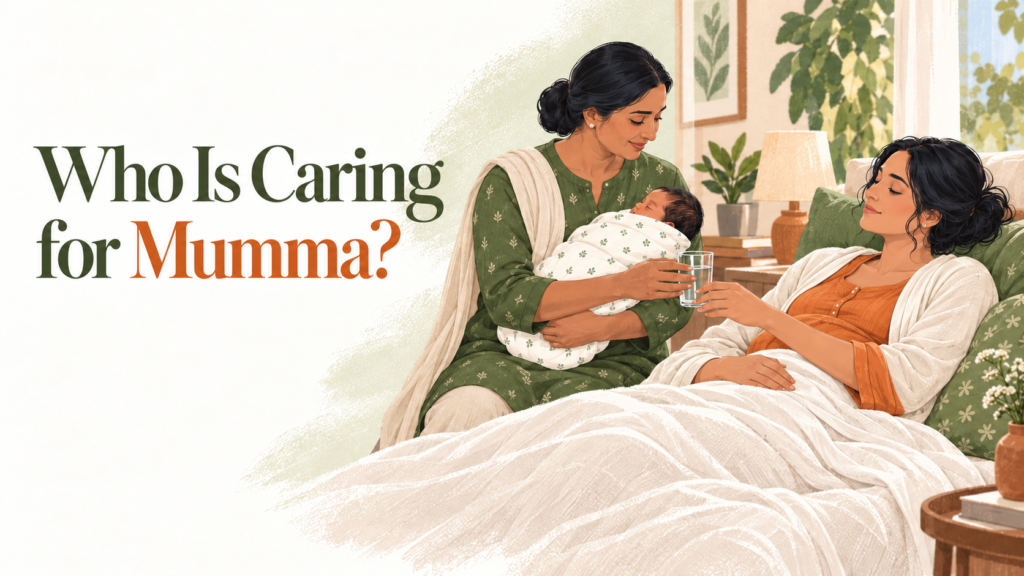
There is always a question waiting after a baby is born.
“Baby ne feed kiya?”
“Baby soya?”
“Baby theek hai?”
And rightly so. A newborn needs care, attention and reassurance.
But somewhere between the feeding schedules, diaper changes, visitors and advice, there is another person who is recovering too.
Mumma.
Her body has just been through childbirth. She may be healing from stitches or a C-section. She may be learning to breastfeed. She may be sleeping in short, broken stretches. She may be tired, sore, emotional or simply trying to understand this completely new version of herself.
And yet, the conversation often becomes:
“Baby is fine. Now you just rest.”
But what does rest actually look like when there is a newborn to feed, hold, soothe and care for?
Postpartum recovery is more than “just rest”
The weeks after birth are a period of significant physical and emotional change.
The World Health Organization considers the first six weeks after birth an important period for the health and wellbeing of both mother and baby. Quality postnatal care is not only about checking the newborn; it also includes the mother’s physical recovery, emotional wellbeing, breastfeeding support, information, reassurance and continued care.
That means Mumma’s recovery deserves attention too.
Her pain matters.
Her sleep matters.
Her nutrition matters.
Her emotional wellbeing matters.
Her questions matter.
And sometimes, what she needs most is simply someone there.
Because caring for a newborn is not the only job
A new mother is often doing several things at once:
Recovering from birth.
Her body needs time and appropriate care to heal.
Learning to feed her baby.
Breastfeeding can take time, patience and the right support.
Learning her baby.
Every cry, feeding cue and little movement is new.
Managing exhaustion.
Broken sleep can make even simple things feel overwhelming.
Adjusting emotionally.
Motherhood can bring joy, uncertainty, confidence, tears and everything in between.
She shouldn’t have to navigate all of this alone.
This is where the village matters
For generations, Indian mothers often had someone nearby.
A mother.
A mother-in-law.
A sister.
A Dadi.
A Nani.
A Jaapa caregiver.
Someone who had been through this before and could quietly say:
“You rest. I’ll take care of this.”
Modern families may live differently now. Grandparents may be in another city. Families may be smaller. Both parents may be working. And the village that once surrounded a new mother may simply not be at home anymore.
But the need for support hasn’t disappeared.
WHO also recognizes the importance of partners, families and communities in creating a positive postnatal experience.
So, who takes care of Mumma?
Not instead of her doctor.
Not instead of her family.
And certainly not instead of her own choices.
But alongside them.
A trained Jaapa caregiver can help make the early days at home more manageable supporting newborn care, helping Mumma rest, assisting with everyday routines and being there through the questions that inevitably come.
And when something needs medical attention, Mumma should have access to the right professional support.
A pediatrician for the baby.
A gynecologist for Mumma.
A lactation consultant when feeding needs support.
A psychologist when emotions become difficult to navigate.
Because postpartum care was never meant to be a one-person job.
It is a team.
Mumma deserves to be cared for, too.
At Mamaraa, we believe the arrival of a baby shouldn’t mean the mother disappears from the care plan.
We bring together trained Jaapa caregivers, medical access, newborn support, wellness and recovery tracking to make the postpartum journey more structured, supported and comfortable at home.
Because the baby needs care.
And Mumma does too.
Support when it matters most.